
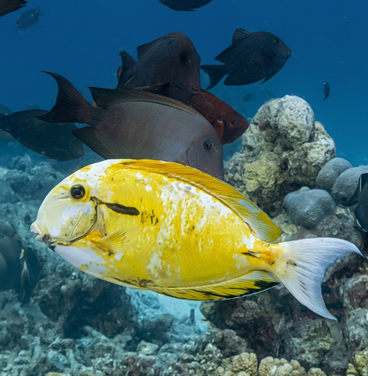
Divers spend years exploring coral reefs hoping for that one encounter — the fish that stops you mid-fin-stroke and makes you question everything you thought you knew. For Maldivian diver Reehan, it has happened more than once. Between 2023 and 2025, he documented three separate surgeonfish displaying dramatic colour aberrations across two different Maldivian atolls — a run of sightings that is, by any measure, extraordinary.
Three Fish That Shouldn't Look Like That
The Eyeline Surgeonfish (Acanthurus nigricauda) — Baa Atoll
The Eyeline Surgeonfish is a familiar face on Indo-Pacific reefs. Reaching up to 45 cm, it is typically grey-brown with a distinctive long black streak running behind the eye, a second black streak extending forward from the caudal spine, a whitish tail base, and a pale outer half on the pectoral fin. Reliable. Recognisable. Unremarkable, to most divers.
Reehan's first two were anything but.
The 2023 individual was the first to be encountered on a shallow reef in Baa Atoll — and it stopped him in his tracks. Swimming among a school of normally-coloured Eyeline Surgeonfish, it stood out immediately: a body dominated by vivid yellow and creamy white, with only faint remnants of dark pigment around the face and fins, and a clean white tail. The yellow coloration is a hallmark of xanthochromism — an abnormal expression of yellow pigment — layered on top of widespread depigmentation. The contrast against its dark schoolmates was startling.
The 2024 individual, found on the same reef just a year later, presented differently but no less dramatically — large irregular patches of black and creamy white across the body, a pale blue-white tail, and vivid orange facial markings. This pattern points more clearly to piebaldism, an irregular patchy loss of pigmentation producing a bold black-and-white mosaic. The body shape, fin structure, and characteristic scalpel-spine at the caudal peduncle confirmed the species in both cases. Everything else about their appearance defied it.
The Pencilled Surgeonfish (Acanthurus dussumieri) — Lhaviyani Atoll
In 2025, Reehan's eye caught something unusual again — this time in Lhaviyani Atoll. The subject was a Pencilled Surgeonfish, a species normally recognised by its dark brown body covered in fine blue and yellow pencil lines, a yellow-orange band across the eyes, a blue spotted tail, and yellow dorsal and anal fins. Elegant and distinctive in normal form.
This individual was dramatically different — a predominantly dark body interrupted by bold white and orange-yellow patches in an irregular pattern, with a pale tail. The aberration disrupts the species' normally intricate fine patterning entirely, replacing it with a high-contrast mosaic more reminiscent of a painted canvas than a reef fish. It is another clear case of piebald-type depigmentation, though expressed differently from either of the Baa Atoll Eyeline individuals — a reminder that even within the same broad mechanism, no two aberrations look alike.
What Causes This?
This kind of dramatic departure from normal coloration is known as aberrant coloration or a colour aberration, and it's genuinely rare in wild fish. The three individuals here appear to represent distinct types:
Xanthochromism — an abnormal overexpression of yellow pigment combined with loss of dark pigmentation, likely responsible for the striking yellow-and-white appearance of the 2023 Eyeline individual
Piebaldism — a specific form of leucism causing irregular patchy depigmentation, producing the dramatic high-contrast mosaics seen in both the 2024 Eyeline and 2025 Pencilled Surgeonfish
Leucism more broadly — a partial loss of pigmentation caused by a reduction in melanocytes (pigment-producing cells), resulting in white or pale patches while some other pigments remain
Genetic mutation — a spontaneous error in the genes controlling pigment expression, present from birth in all three cases
That three differently-expressing aberrations have been documented across two surgeonfish species in two Maldivian atolls within three years — all by the same observer — speaks as much to the quality of attention being paid as to any unusual concentration of anomalies. It is a reminder that these fish may be out there more often than we think, simply going unnoticed.
Why the Maldives?
Both atolls in this story are exceptional marine environments in their own right.
Baa Atoll has been a UNESCO Biosphere Reserve since 2011, covering over 139,000 hectares of reef, seagrass, and mangrove habitat. It is home to 250 species of coral and over 1,200 reef fish species, alongside manta rays, whale sharks, and multiple threatened turtle species. It is widely regarded as one of the most biodiverse reef systems in the Indian Ocean — and the high volume of experienced divers in its waters means unusual individuals are more likely to be found and photographed.
Lhaviyani Atoll, located further north, is equally renowned among the diving community. Known for its healthy coral reefs, deep channels, and preserved island culture, it hosts above-average stingray populations, healthy hard coral ecosystems, and some of the Maldives' best house reefs. With over fifty dive sites and water visibility regularly exceeding 30 metres, it is a destination where careful observers are richly rewarded.
Together, these two atolls represent the kind of pristine, high-biodiversity environment where aberrant individuals have the best chance of surviving — and being seen.
Left Where They Belong
Despite the obvious rarity and commercial value these fish would command in the marine aquarium trade, all three were photographed, documented, and left undisturbed on their reefs.
That choice matters. Aberrant fish are highly sought after by collectors, and specimens with dramatic coloration can fetch significant sums in the hobby market. The temptation to collect such one-of-a-kind animals is real — but so is the scientific and ethical argument for leaving them in place. Living, wild individuals contributing to a healthy reef ecosystem are worth far more than specimens in a display tank. Their continued presence also means future divers may encounter and photograph them, building a richer record of how these aberrations develop over time.
It is a meaningful example of conservation-minded diving — and exactly the kind of decision that keeps places like the Baa Atoll Biosphere Reserve and Lhaviyani's reefs worth protecting.
You're Not Alone: The Hobby Is Watching Too
These Maldivian sightings are not isolated cases. The marine aquarium hobby has increasingly become an unexpected front line for documenting colour aberrations in tangs — and a near-white Scopas Tang (Zebrasoma scopas) recently made waves when it was displayed by Koral King at Reefapalooza, one of the largest saltwater aquarium trade shows in the United States. The fish, caught by a diver, exhibited an almost complete loss of its normal brown pigmentation — an extreme leucistic expression rarely seen in this species.
Taken together — three wild aberrant surgeonfish documented across the Maldives and a near-white Scopas making its debut at a reef trade show — these sightings point to a growing awareness across both the scientific and hobby communities that colour aberrations in surgeonfishes deserve closer attention and more systematic documentation.
This body of sightings may not represent new species or scientific firsts, but each confirmed, photographed record carries genuine scientific value. Colour aberrations are so rarely documented in wild surgeonfishes that a run of three in three years, by one observer, is the kind of dataset researchers notice.
If you encounter something like this on a reef dive, photograph it from multiple angles, note the exact location and depth, and consider reporting it to a local marine research institute or submitting it to a citizen science platform such as iNaturalist. The ocean is full of individuals that don't read the field guides — and the more we document them, the better we understand the full range of what life on a coral reef can look like.